



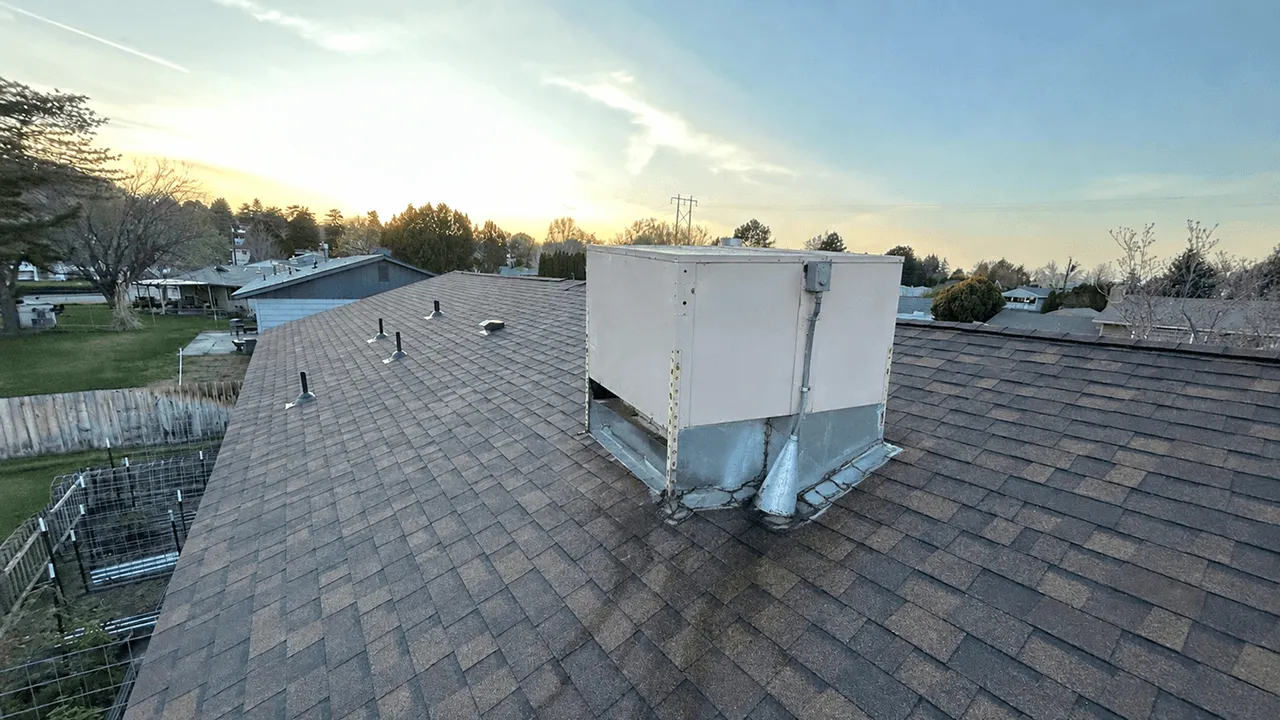
A swamp cooler roof leak in Richland usually starts at the roof seal. Here's how to spot it, stop it, and know when to call a roofer.
A swamp cooler roof leak in Richland almost always starts at the roof seal, not the cooler unit itself. Richland's dry climate keeps swamp coolers running most of the summer, and that steady vibration and heat cycling wears the seal down year after year. After years of chasing these leaks across Tri-Cities roofs, I have learned a swamp cooler roof leak in Richland is usually an easy fix if you catch it early. Here is where to look first.
Quick Answer: What Causes a Swamp Cooler Roof Leak in Richland
A swamp cooler roof leak in Richland almost always comes from one of three spots. The roof penetration where the unit's curb or stand meets the roof deck, the sealant or "pitch pan" packed around the support legs, or the drain pan and duct boot that route water away from the unit. None of these parts are built to last forever. Sun, heat, and constant vibration from the cooler running all summer slowly crack the sealant and loosen the flashing. Once that seal fails, water does not always drip straight down. It often travels sideways under the shingles first, so the stain on your ceiling can show up several feet from where the water actually got in.
What Homeowners in Richland Usually Notice First
Most homeowners do not spot the roof problem directly. They notice a ceiling stain in a hallway or closet that only shows up during the hottest stretch of summer, right when the swamp cooler is running the most. A musty smell in that same closet, even without visible water, is another early sign.
I worked on a home near Badger Mountain a couple summers ago where the homeowner had painted over the same ceiling stain twice, assuming it was an old, dried-out leak from before she bought the house. It was not old at all. Every time the cooler kicked on for the season, a small amount of water crept in through a cracked pitch pan seal and worked its way along the decking before dripping down in that one spot.
The stain only grew because the swamp cooler roof leak in Richland was active every summer, not because the original damage was still spreading on its own.
What a Roofer Looks For During a Swamp Cooler Roof Leak Inspection
On many roof inspections tied to a swamp cooler complaint, we check the same handful of spots in a specific order, because that order tells us where the water from a swamp cooler roof leak in Richland is actually getting in.
First, the pitch pan or curb flashing. A roofer evaluates this by looking at the sealant packed around the base of the unit's support legs or curb. Cracked, shrunken, or missing sealant here is the single most common entry point I find.
Second, the duct boot gasket where the cooler's ductwork passes through the roof. Rubber gaskets dry out and split faster than the surrounding shingles because they sit directly under the unit's shadow and take extra heat cycling from the equipment itself.
Third, the drain pan and overflow line. What homeowners often miss is that a cracked or clogged drain pan can overflow onto the roof deck even when the roof's own flashing is in perfect condition, which is why I always check the pan before assuming the leak is a roofing problem at all.
Fourth, the direction of water staining on the underside of the decking, visible from the attic. This tells me whether water is entering right at the unit or migrating in from a separate, older roof issue nearby.
Common Mistakes Homeowners Make With a Swamp Cooler Roof Leak
The most common mistake is caulking the ceiling stain from inside the house instead of fixing the roof seal itself. That only hides the sign of the leak. The water is still getting in above it, and it will keep finding the same path, or a new one nearby, the next time the cooler runs.
The second mistake is running the cooler through the whole leak season before calling anyone, hoping it dries out between uses. A swamp cooler roof leak in Richland rarely heals on its own. Each hot week the seal stays cracked, more water works its way further under the shingles and decking.
The third mistake, and the one I want to be direct about, is climbing onto the roof to reseal the unit without knowing what is underneath the existing seal. A roof penetration this size needs to be resealed and flashed correctly the first time, and any structural or flashing repair should be handled by a registered, insured roofing contractor rather than a quick tube of roofing cement from the hardware store.
Deciding Between a Reseal, a Flashing Rebuild, or Removing the Unit
A simple reseal is usually enough if the leak is caught early and the curb, decking, and flashing underneath are still in solid shape. Most early-stage cases of a swamp cooler roof leak in Richland fall into this category and make for a quick, affordable fix.
A full flashing rebuild is the better call if the wood curb has softened from years of water intrusion, or if the pitch pan has been patched with layer after layer of roofing cement that is now failing as a whole unit rather than in one small spot.
If the swamp cooler itself is old and you are considering switching to central air down the road, it is often worth discussing whether to remove the unit entirely and properly cap and reroof that section, rather than repairing a penetration you plan to remove in a year or two anyway.
Richland's Dry Climate Is Exactly Why This Happens So Often
Swamp coolers work well here because Richland's summer air is hot and low in humidity, which is exactly the kind of climate evaporative cooling depends on. That same climate means these units run for months at a time, often from May through September, which is far more continuous heat cycling on that one roof penetration than a typical vent pipe or skylight ever sees. A swamp cooler roof leak in Richland is really a maintenance timeline problem as much as a weather problem. The parts wear out because the units run so much, not because of any single storm or event.
Get the Seal Checked Before the Next Hot Stretch
If you have noticed a stain near where your swamp cooler sits, or you simply cannot remember the last time anyone checked that seal, it is worth having it looked at before the next run of hot days. Our Roof Repairs team checks the pitch pan, flashing, and drain pan the right way, and gives you a straight answer on whether it is a simple reseal or something bigger. If you would rather talk it through face to face, visit us in Kennewick, WA, and we can walk you through what we found on similar jobs nearby.
Notice a stain near your swamp cooler? Have Terry check the seal before it becomes a ceiling repair.
QUESTIONS
FREQUENTLY ASKED QUESTIONS
Timing is the biggest clue. A swamp cooler roof leak in Richland usually shows up during hot, dry stretches when the unit is running constantly, not necessarily during or right after a rainstorm. If your stain grows worse on the hottest days of summer and stays dry through a rainy stretch in the fall, the cooler's roof seal is almost always the source.
You can apply a temporary bead of roofing sealant around visible cracks, but that only buys time. It does not tell you whether the decking underneath is still solid or whether the drain pan is also cracked. For anything beyond a temporary patch, it is worth having a registered contractor check the full penetration, since a poor reseal job can trap moisture underneath and make the damage worse.
A straightforward reseal and flashing touch-up is usually one of the more affordable roof repairs we do, often completed same day. A full curb or flashing rebuild costs more, since it involves removing the unit temporarily, replacing damaged decking, and rebuilding the pitch pan or flashing from scratch. The exact number depends on how far the water has traveled and how much decking needs replacing.
If you are planning to switch to central air conditioning within the next year or two, capping the roof properly once you remove the unit is often smarter than repairing a penetration you will remove soon anyway. If you plan to keep using the swamp cooler for several more summers, a proper reseal or flashing rebuild is usually the better investment.
Generally, no. This type of leak is considered gradual wear on equipment and its roof seal rather than a sudden, storm-related event, and most policies treat ongoing maintenance issues differently than storm damage. We are a licensed, registered contractor, not an insurance agent or public adjuster, so we cannot make coverage decisions. We can give you a written estimate and clear photos of what we found, which you can bring to your insurer yourself.
I recommend a check every spring before you turn the unit on for the season, since that is the easiest time to catch a cracked seal before months of heavy summer use make it worse. If your swamp cooler is more than eight to ten years old, it is worth a closer look even if you have not noticed any staining yet.

Terry Preston, Owner-Operator. Published August 2026.