



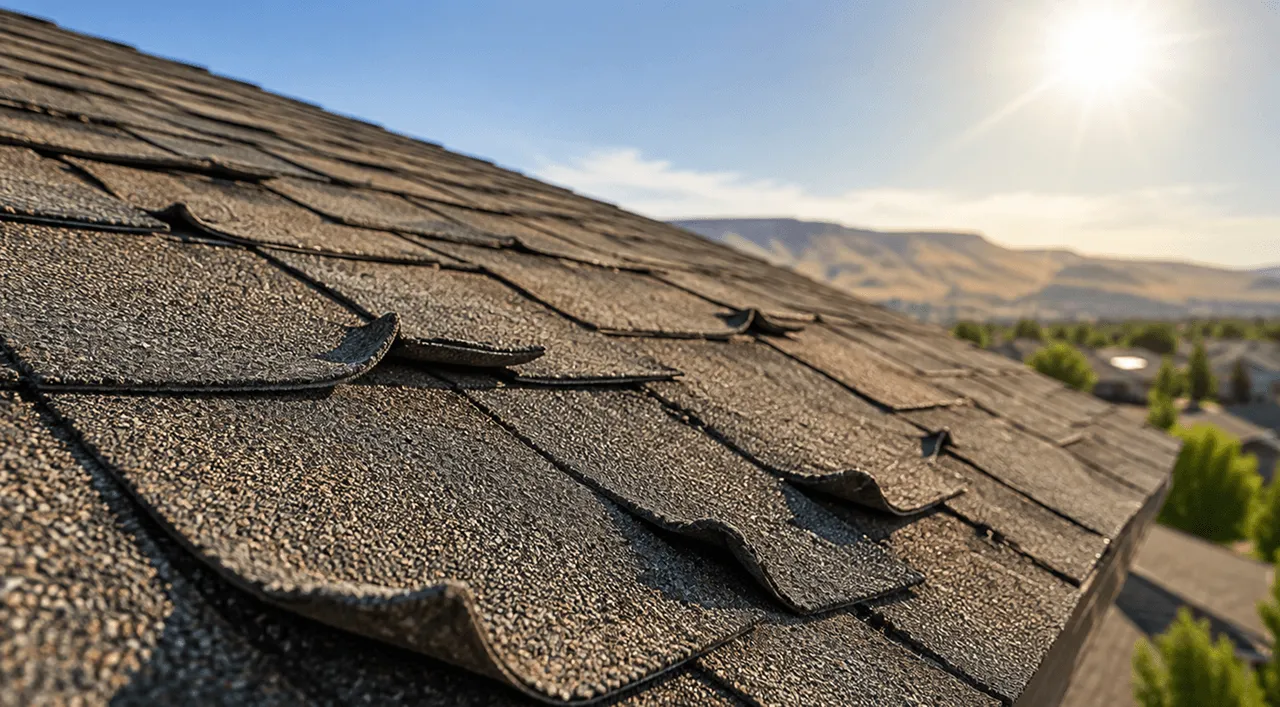
Roof heat damage in Kennewick shows up sooner than most homeowners expect. Here's what causes it, what to watch for, and when to call a roofer.
Roof heat damage in Kennewick shows up years before most homeowners expect. Summer highs here often top 100 degrees, baking shingles from the top down long before a leak appears. After 25 years on Tri-Cities roofs, I have learned roof heat damage in Kennewick usually shows up first as granule loss and curling edges. Here is what to watch for.
Quick Answer: What Causes Roof Heat Damage in Kennewick
Roof heat damage in Kennewick happens because the sun here is stronger and steadier than in most of Washington. Summer afternoons regularly pass 100 degrees, and shingles sit exposed to that heat for hours with almost no cloud cover to soften it. The asphalt inside each shingle slowly dries out, the protective granules on top loosen, and the edges start to curl upward. None of this happens overnight. It builds up one hot summer at a time, which is why a 12-year-old roof in Kennewick can look and perform like a 20-year-old roof somewhere cooler and cloudier.
What Homeowners in Kennewick Usually Notice First
Most homeowners do not notice heat damage on the roof itself. They notice it in smaller, easier-to-miss places. A gutter clean-out that turns up more sandy granules than usual. A shingle color that looks blotchy or washed out compared to a few years back. An upstairs bedroom that stays hot long after sunset, even with the air conditioner running.
One homeowner in the Southridge area called me after her son mentioned the garage felt like an oven all summer. She was not calling about a leak. Nothing had ever dripped. But when I climbed up, the south-facing slope had lost enough granules that the black asphalt mat was showing through in several spots, and the attic insulation below it had baked to the point of losing some of its effectiveness. That is a common pattern with roof heat damage in Kennewick. It almost always shows up first as comfort and energy bills, long before it shows up as water in the ceiling.
I see this pattern often enough that I now ask about upstairs comfort and summer energy bills on nearly every inspection, even when the homeowner only called about something else entirely.
What a Roofer Looks For During a Heat Damage Inspection
On many roof inspections we see the same early warning signs, just in different combinations. A roofer evaluates this by looking at four things up close, not from the driveway with binoculars.
First, granule loss. I run a hand across a few square feet of each slope, especially the south and west-facing sides that take the worst of the afternoon sun. Loose granules coming off on my glove is a sign the shingle's protective layer is thinning.
Second, shingle curling. I check the edges and corners of shingles for lifting or cupping. Heat-cycled shingles curl because the asphalt expands in the heat of the day and contracts again at night, and after enough summers that constant flexing stops springing back.
Third, nail pops. The same expansion and contraction that curls shingles also works nail heads loose over time, especially on the sunniest slopes. A popped nail is a future leak waiting for the right rainstorm.
Fourth, attic heat and ventilation. What homeowners often miss is that a roof does not fail from the top down alone. It also fails from the inside out, when trapped attic heat cooks the underside of the decking and shortens the shingles' life from below. I check soffit and ridge vents to see if hot air is actually escaping or just sitting there.
Common Mistakes Homeowners Make With a Heat-Damaged Roof
The biggest mistake is waiting for a leak before calling anyone. Roof heat damage in Kennewick is progressive. By the time water reaches the ceiling, the underlying damage has usually been building for several summers, and the repair is bigger than it would have been two years earlier.
The second mistake is assuming shade trees or a lighter shingle color already solved the problem. Shade helps, and lighter colors reflect more heat, but neither one stops the slow drying-out process on a roof that is already 10 or 15 years old. I have inspected plenty of shaded, light-colored roofs in West Richland and Kennewick that still showed real granule loss on the sun-exposed side of the same roof, which tells you the shade only protects the section it actually covers.
The third mistake, and this one matters for your wallet, is confusing ordinary sun and heat wear with storm damage. Heat-related aging is normal wear over time, not a sudden event, and it is generally treated differently than wind or hail damage when it comes to what an insurance policy actually covers. I always tell homeowners the honest version rather than the version that sounds better on the phone.
Deciding Between a Repair and a Full Replacement
This is where the age of the roof matters as much as the damage itself. A roof under 10 years old with isolated granule loss on one slope is usually a good repair candidate. A roof past 15 years old with curling across multiple slopes, plus nail pops and reduced attic ventilation, is usually past the point where a patch makes financial sense.
I will not push a full replacement on a roof that still has good years left in it. A written inspection report, with photos of exactly what I found and where, gives you an honest starting point to make that call yourself. If the report shows widespread roof heat damage in Kennewick across every slope, replacement is usually the more cost-effective path over the next few years, since patching one section rarely stops the same aging process on the rest of the roof.
Kennewick's Climate: Why the Heat Here Hits Roofs Harder
This is not just a feeling. The National Weather Service office that forecasts for the Tri-Cities has recorded Kennewick summer highs regularly reaching into the 90s and past 100 degrees in peak July heat. Regional climate data from the Western Regional Climate Center shows that interior valleys east of the Cascades, which includes the Tri-Cities, receive roughly 80 to 85 percent of possible sunshine during summer months, compared to well under that on the wetter west side of the state.
That combination, high heat and very little cloud cover to interrupt it, is exactly why roof heat damage in Kennewick tends to move faster than the shingle manufacturer's general lifespan chart assumes. Those charts are usually built around a national average climate, not a high desert one. It is also why I tell homeowners in Pasco and Richland, who share the same weather pattern, to expect the same accelerated wear on their own roofs.
Get an Honest Look Before the Damage Spreads
If any of this sounds familiar, whether it is a hot upstairs room, granules showing up in the gutter, or a roof that is simply getting up there in age, the smart move is a real inspection rather than a guess. Our Roof Inspections service gives you a written, photo-backed report of exactly what your roof needs, with no pressure to buy anything you do not need. If you would rather talk it through in person, visit us in Kennewick, WA, and we will walk you through what we look for.
See real heat damage on your own roof. Book a free inspection, and get a straight answer instead of a sales pitch.
QUESTIONS
FREQUENTLY ASKED QUESTIONS
Check your gutters after a windy day. A normal amount of grit is fine, but a handful of loose granules that look like coarse sand is a sign of roof heat damage in Kennewick starting to set in. Also look at your roof from the street in the strong afternoon light. Curling or lifted edges usually show up as small shadows along the shingle tabs that are not visible from a flatter viewing angle.
Yes, but only partly. Lighter shingles reflect more solar radiation than dark ones, which can lower shingle surface temperature by a noticeable margin. It helps extend the shingle's life, but it does not eliminate the heat and UV exposure problem entirely, especially on south and west-facing slopes that take the most direct sun in the Tri-Cities.
Generally, no. Heat and sun-related wear is treated as gradual, expected aging rather than a sudden covered event like wind or hail. We are a licensed, registered contractor, not a public adjuster or insurance agent, so we cannot make coverage decisions for you. What we can do is give you an honest, written condition report so you know what you are actually dealing with before you call your insurer.
It depends entirely on how much of the roof is affected and whether the damage is isolated or spread across multiple slopes. A small section with granule loss and a few curling shingles is a straightforward repair. Widespread roof heat damage in Kennewick across the whole roof, especially on a roof already past 15 years old, usually points toward planning for a replacement instead of repeated patch jobs.
Almost always. South and west-facing slopes take the most direct afternoon sun and show granule loss and curling first. North-facing slopes, especially ones shaded by trees or a neighboring structure, tend to hold up noticeably longer under the same roof age and materials.
I recommend a visual check every year, ideally in early fall after the hottest stretch of summer has passed. A closer, hands-on inspection every two to three years catches the early granule loss and nail pop stage, while it is still a repair instead of a replacement.

Terry Preston, Owner-Operator. Published August 2026.